
BestOnlyFans ranking cards exist to make the renewal moment less of a guess. Instead of discovering a creator for the first time, you are deciding whether the next billing cycle still deserves your budget. That decision needs structured data: what the price has done lately, how often the creator posts, and how fresh the numbers on the card actually are. BestOnlyFans refreshes its rankings every month.
A ranking card is a compact snapshot that aggregates observable platform behavior into columns you can compare across creators. The value is not in any single number but in how the numbers move over time and how recently they were captured. Read the card wrong and you cancel a creator who is simply between posting cycles; read it right and you stop paying for a page that has quietly gone dormant.
Ranking Card Architecture and Data Sources
OnlyFans itself has no built-in discovery feed or public directory, so third-party ranking sites assemble cards from observable page behavior: subscription price at the moment of capture, publishing cadence, and changes over time. The BestOnlyFans method stays consistent across updates, which matters because consistency is what makes historical comparison possible.
A card typically carries four moving parts, each measuring a different slice of creator behavior:
- Current base price — the listed monthly subscription cost, which on paid pages must sit between $4.99 and $49.99. A $0 entry means a free page that earns through pay-per-view and tips instead.
- Price history window — the recorded sequence of past price points, which shows whether the creator has raised, cut, or held the rate.
- Posting frequency estimate — a count of visible posts over a recent interval, used as a proxy for how much new material a renewal would buy.
- Timestamp and rank position — when the card was last updated and where the creator sits relative to others in the same category.
These components measure consistency, pricing confidence, and recency of activity — three things that correlate with whether a renewal feels worthwhile.
Reading Price History Trajectories for Stability
A single number tells you almost nothing; the shape of the line tells you whether a creator is confident, testing, or scrambling.
- Stable pricing — the base price has held at the same point across multiple captures, often somewhere in the typical $4.99 to $15 band. Stability usually signals a creator who has settled on a rate and is not chasing volume through discounts.
- Gradually increasing pricing — small step-ups over months, each modest. This often tracks a growing audience and is a reasonable sign that demand supports the new rate.
- Spiky or volatile pricing — sharp jumps followed by promotional drops, or repeated swings. Volatility can mean aggressive testing, seasonal promotion, or a creator reacting to churn rather than planning around it.
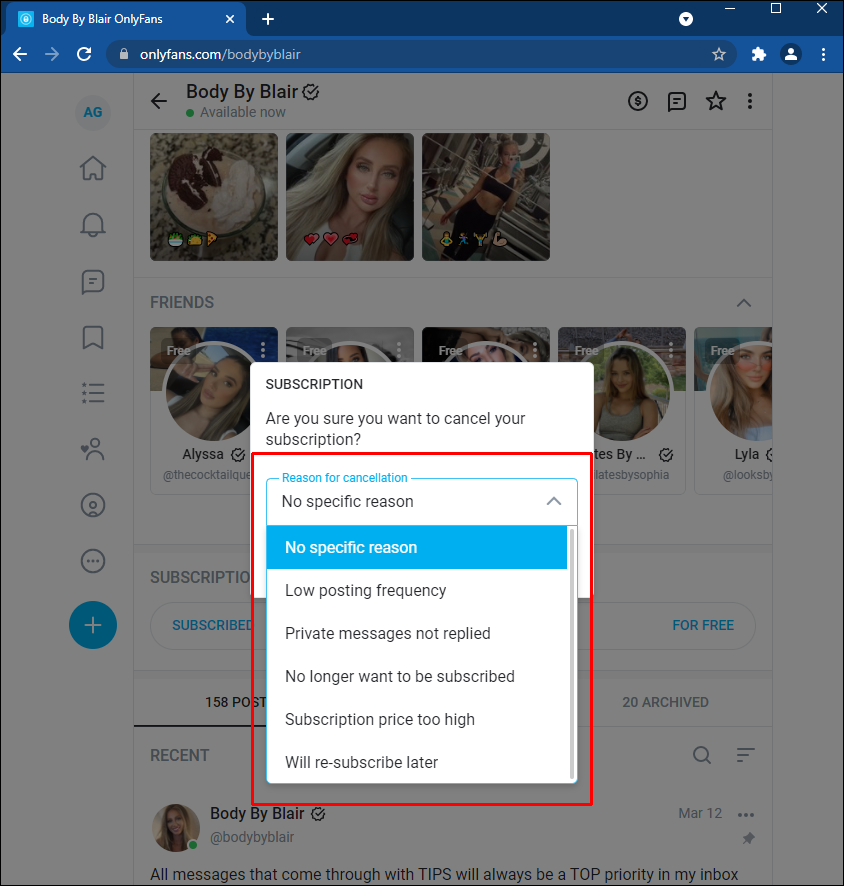
One platform mechanic matters for renewal specifically: when a creator raises the price, auto-renew stops for existing subscribers. Your access lasts until the paid period ends, but you will not be charged again unless you opt back in. A card showing a recent price increase is therefore a direct prompt to check your own renewal status rather than assume nothing changed.
Promotional first months can sit below $4.99 — a $3 first month is legitimate — but the base price may not. If a card shows a headline number under the minimum with no promotion note, treat the entry as ambiguous rather than as a permanent rate.
Tip: before renewing, compare the price on the card with the price shown in your own subscription settings. A mismatch usually means the card captured a promotional rate that no longer applies to your renewal.
Post Frequency Metrics and Value Preservation
A subscriber who pays $9.99 and receives two posts a week is comparing that against every other recurring charge in their budget.
| Posts Per Week Range | Typical Subscriber Satisfaction | Renewal Risk Level |
|---|---|---|
| 7 or more | High engagement, low churn perception | Low |
| 3 to 6 | Steady, acceptable for most paid tiers | Low to moderate |
| 1 to 2 | Value questioned at higher price points | Moderate |
| Less than 1 | Page often perceived as dormant | High |
Frequency should always be read alongside price. A creator posting twice weekly at $4.99 is a different proposition from one posting twice weekly at $29.99. The same interval carries different weight at different price points, and the card gives you both numbers side by side.
That combination is the most common precursor to a renewal that feels wasted, and it is usually visible on the card before it is visible in your own satisfaction.
Timestamp Freshness and Decision Reliability
A price captured three months ago may have changed twice since, and a frequency estimate from that window says nothing about this month.
Use these freshness thresholds as a rough filter before you act on any card:
- Updated within 7 days — reliable enough to base an immediate renewal decision on, assuming the other signals agree.
- Updated 8 to 14 days ago — usable for context, but verify price directly in your subscription settings before renewing.
- Updated 15 to 30 days ago — treat as background only; do not cancel or renew on this alone.
- Updated 31 to 90 days ago — historical reference, effectively a different subscription period.
- No timestamp visible — treat the entire card as unverified and rely on your own account data instead.
Freshness interacts with volatility. A stable creator can be accurately described by a two-week-old card; a creator with spiky pricing cannot. The more the history moves, the shorter the useful shelf life of the snapshot, and the more you should confirm before committing another month.
Ranking Position Volatility and Creator Trajectory
Movement up or down does not measure content quality directly; it measures change in the observable signals the ranking weighs, which in practice means activity and pricing behavior.
| Movement Pattern | Creator Interpretation | Subscriber Action |
|---|---|---|
| Rising steadily over weeks | Increasing posting investment or audience pull | Renew and monitor price for increases |
| Flat and stable | Consistent routine, predictable output | Renew if your own experience still matches |
| Sharp one-week jump | Possible promotion or a single burst of activity | Wait for a second capture before acting |
| Gradual decline over months | Reduced posting or waning platform focus | Review before renewing; consider pausing |
| Erratic up-and-down swings | Inconsistent publishing or promotional cycling | Rely on price and frequency columns instead |
A rising rank with falling frequency usually means the movement came from something other than output, and that gap is worth noticing.

Integrating Card Signals With Personal Budget Cycles
Aligning when you review cards with when your charges actually hit turns scattered decisions into one planned check.
- List your renewal dates — note the billing day for each subscription so you know which decisions are due in the next two weeks.
- Check card freshness first — only act on cards updated within the last 14 days, and note the capture date for each.
- Compare price and frequency together — flag any creator whose price rose or whose posting interval dropped since your last review.
- Decide before the charge, not after — cancellation and renewal both take effect around the billing boundary, so make the call a few days early.
Free pages cost $0 per month and earn through pay-per-view messages and tips, so a free page never triggers a renewal decision at all — but PPV unlocks up to $50 each and tips can reach $100, so the spending still needs a line in your budget. Paid chat commonly runs $3 to $5 per message. For subscribers who track creators across categories, curated roundups such as best onlyfans daily posts can supplement card data by showing which pages are active right now.
Remember that the platform takes a 20% fee on everything, with the creator keeping 80%, so a creator’s stated price is not their full take-home. That gap matters when you are judging whether a price rise reflects genuine demand or a creator trying to offset platform costs. Either way, the number that affects your budget is the listed price, not the split behind it.
Messages asking you to re-enter card details through a link, or claiming a subscription failed when your account shows otherwise, follow the standard patterns of phishing attempts and should be verified inside your account settings instead. Enabling two-step authentication closes the most common route these attempts rely on. Never treat a message, however urgent, as more trustworthy than your own billing page.
Limitations and Blind Spots in External Rankings
Ranking cards are aggregates of visible behavior, and a great deal of subscriber value is invisible to them. Being explicit about the blind spots prevents you from treating a card as a complete picture when it is one narrow slice.
- PPV message frequency and pricing — how often a creator sends paid messages and at what unlock price is not captured on standard cards.
- Content quality gradient — production effort, consistency of theme, and personal style cannot be reduced to a posting count.
- Direct message responsiveness — reply speed and conversation quality vary widely and rarely appear in ranking data.
- Custom and bundled offers — discounted multi-month bundles or personalized deals are usually negotiated privately.
- Behind-the-scenes changes — hiatuses, equipment issues, and life events that temporarily reduce output are not annotated on cards.
A card that looks weak may describe a creator on a two-week break rather than one who has lost interest. A card that looks strong may describe a burst of promotional posting that will not repeat. Both cases argue for the same habit: use the card to narrow your attention, then confirm with the live page and your own experience before the charge lands.
FAQ
How often does the ranking site refresh its pricing data for ranking cards?
Always read the timestamp on the card rather than assuming a fixed schedule, and verify price in your own subscription settings before renewing.
Can a creator’s ranking position drop due to factors unrelated to content quality?
A short break, a promotional cycle ending, or a pause in publishing can move a creator down the list even when the material itself has not changed at all.
What does a flat price history combined with declining rank indicate about a creator?
For a renewal decision, that combination favors checking recent posts directly before committing another month.
Should I rely solely on this directory data when deciding whether to renew a subscription?
Confirm the current price in your subscription settings, check the freshness timestamp, and weigh what you personally received during the last paid period.